Showing posts with label Bolivia. Show all posts

Sunday, September 1, 2013

The South American Altiplano March 2013 - Exploring La Paz

***This post is part 8 of a full trip report. The index can be found here***

La Paz is a fascinating city to me primarily because of its unique location and layout. First off, it is the highest seat of government in the world. Assigning an actual altitude to the city, however, is difficult because the number ranges from about 10,170 feet to 13,313 feet at the border of El Alto, where the international airport is located. What other city in the world do you know covers an altitude range of nearly 3,200 feet?

Taking a bus into La Paz from the outskirts of the city gives you a good idea of its unusual topography. As you descend from dizzying heights along the edge of town, views of the massive sprawl set inside a wide, deep canyon are simply astonishing. At the very bottom of this canyon lies the heart of the city. From here, La Paz has grown outwards and upwards, spreading beyond the slopes until it finally reached the high plateau to the west.

Because the weather and effects of altitude grow milder as you descend into the canyon, the wealthiest residential districts and business centers are all located at the bottom, while the surrounding hillsides are lined with poorer neighborhoods. At the very top, the adjacent city of El Alto sits on a flat plain with an average altitude of 13,620 feet, making it the world's highest large city. More than a million people live here, many in shanty town-like conditions, and crime and poverty are both significant issues for its residents.

With our delayed arrival into La Paz on the first day, we missed out on a late afternoon of exploring the city. So with just one full day left, we made the most of our time by visiting some of the more prominent sights in town. The weather was beautiful in the morning, and we set off along El Prado, the main street just west of our hotel. The tree-lined road is surrounded by restaurants, department stores, and apartments catering to the mostly middle-class residents of the area. Social activism, of course, plays a prominent role in daily life, and just on our walk, we witnessed a political rally as well as a tent city protest.

Start of El Prado


Political rally

Tent city protest

Tuesday, August 27, 2013

The South American Altiplano March 2013 - Radisson Plaza Hotel La Paz

***This post is part 7 of a full trip report. The index can be found here***

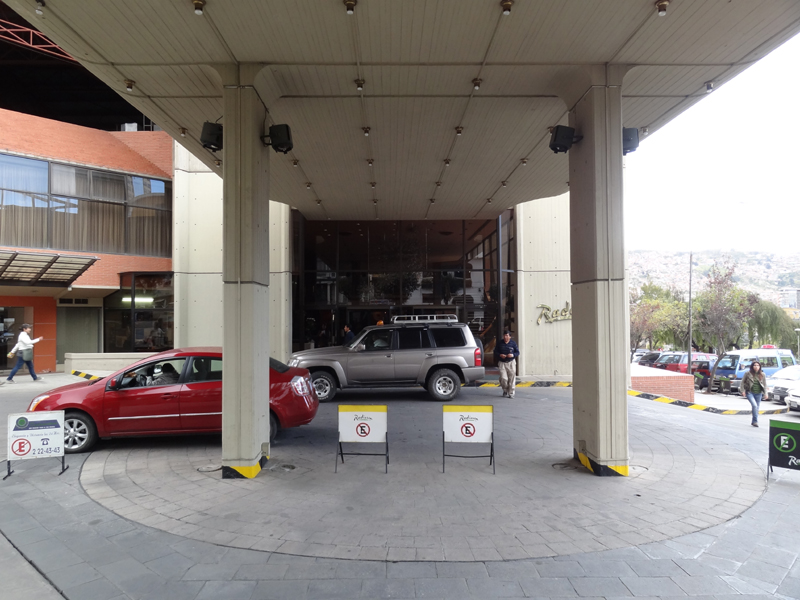
The Radisson Plaza Hotel is the only international chain in La Paz, but don't go there expecting international standards in decor and upkeep. In its heyday (probably a few decades ago), this was certainly a five-star hotel with its expansive lobby, full-service amenities, and towering presence over one of the wealthiest districts in La Paz. However, time hasn't been particularly kind, and without any major remodeling of the rooms and facilities, everything now looks incredibly dated and tired.

Armed with my U.S. Bank Club Carlson Visa,  I booked two nights here for only 15,000 Gold Points, with the last night free. If I didn't have this benefit, I probably would have just paid for the room out-of-pocket since prepaid nights often go for well under $100 USD. Booking over the Club Carlson website was very straightforward, and they even automatically removed the points deduction for the last night since your credit card and membership accounts are linked.

We arrived at the Radisson Plaza Hotel around 9:00 pm hungry and tired. Thankfully, the wait to check in was short. After an extensive day of traveling, I didn't have the energy or patience to take pictures of the facilities that night, but I did so the next morning. All we really wanted to do was throw our belongings into the room and quickly find something to eat in the area.

Radisson Plaza Hotel La Paz


Lobby


Monday, August 26, 2013

The South American Altiplano March 2013 - Strikes In Copacabana And Detour Through Peru

***This post is part 6 of a full trip report. The index can be found here***

The day prior to leaving Copacabana, we went to the Titicaca Bolivia office to inquire about tickets to La Paz. Tourist buses cost about 30 Bolivianos and depart daily at 1:30 pm, with another possible departure late in the afternoon. There are also local buses that leave every hour for about half the price. 

Besides comfort, the main trade-off is the fact that local buses will drop you off at the cemetery bus terminal in La Paz, which is located in a more dangerous area outside the center of town. There have been documented robberies against tourists here, especially at night, so we opted to play it safe and booked the tourist bus instead.

We were warned, however, that there was a high possibility of a workers strike the next day. When that occurs, all transportation into and out of Copacabana ceases, and we would be left stranded. Of course, our tickets would be refunded. Feeling somewhat helpless, we hoped for the best and returned to the hotel.

Ominously, we woke up the next morning to the sound of loud chants and banging drums. From our windows, we could see a long parade of strikers marching through town.

Strike in Copacabana

Still clinging on to a shred of hope, we quickly got ready, checked out of our hotel, and headed to Titicaca Bolivia to see what the situation was like. Unfortunately, we were informed that all roads out of Copacabana had been blocked by strikers, and even the remaining possibility of taking a boat out of town was unfeasible since the boat drivers were refusing to cross the picket line.

The only way we could leave Copacabana that day would be to walk eight kilometers back to the Peruvian border at Kasani, find a taxi or shared minibus to drive us to the alternate border crossing at Desaguadero approximately an hour away, and then catch a local bus from Desaguadero to La Paz. This would be a huge detour, not to mention a complete waste of time crossing back into Peru and then returning to Bolivia. But it was the only option left.

After we made the decision to hike it out of Copacabana, we left immediately so as not to waste any more time. Behind us were at least another half dozen backpackers who were determined to leave as well. The eight kilometers to the border turned out to be relatively flat, but walking with the weight of all of our belongings under the intense sun was still very strenuous. On the way, we passed by several makeshift roadblocks set up by the strikers, including large stones and toppled tree limbs.

Starting the hike back to the Kasani

Edge of town

Leaving Copacabana behind

Sunday, August 25, 2013

The South American Altiplano March 2013 - Exploring Copacabana And Isla Del Sol

***This post is part 5 of a full trip report. The index can be found here***

Say the word "Copacabana", and the first image that comes to mind may be the sunny beaches of Rio de Janiero. Unbeknownst to many, however, is the fact that the famous Copacabana Beach is actually named after a small town along the shores of Lake Titicaca.

The town's preeminent basilica, one of the oldest churches in Bolivia, houses a revered statue of the Virgen de la Candelaria, to whom many miracles have been attributed. Carved in 1583, the statue turned the community into a pilgrimage site, and its fame quickly spread throughout South America. A replica was created in Rio de Janiero, and a chapel to house it was built along a white-sand beach, whose name was soon changed to Copacabana.

A beautiful place in its own right, Copacabana feels a world away from the rather dingy atmosphere of Puno. The streets were bustling, and the vibrant beach on Lake Titicaca were packed with tourists and locals alike. Maybe it was the gorgeous weather, or perhaps the relaxed demeanor of the locals, but something just made me feel completely at ease here. After a detour by the lakeshore, we hiked up a steep road (no easy feat considering the town is at 12,600 feet) and found our hotel, Hostal Las Olas, prominently situated on a steep hillside.

Main street in Copacabana

Lakeshore

Out of all the places I stayed at on this trip, I was most looking forward to Las Olas. Take a look at their website, and you'll probably understand why. "Hostel" is definitely a misnomer here, as each of the seven suites that make up the property is its own bungalow. And each bungalow has been individually designed like a life-sized art project. I imagine the owner to be some sort of eccentric recluse, because the creative quirks that went into each of these buildings is really quite impressive.

Hostal Las Olas

New seashell suite being constructed

View from the reception

Wednesday, August 21, 2013

The South American Altiplano March 2013 - Crossing Into Bolivia Via Kasani

***This post is part 4 of a full trip report. The index can be found here***

Border crossings by land can be a little tricky, especially when it comes to developing countries. The path between Southern Peru and Bolivia, however, is well-worn with backpackers from across the globe. As such, it is relatively safe and hassle-free. The two main routes in the Lake Titicaca region are either via Desaguadero or Kasani. 

Desaguadero is the larger of the two, and most people who want the fastest and most direct passage to La Paz will choose this course. Kasani is smaller, less chaotic, and more picturesque. It is also the only way to reach Copacabana from Puno. To get from Copacabana to La Paz, you will have to get off the bus at one point and take a ferry across a narrow strait on Lake Titicaca (the bus is ferried across separately by barge). Once you reach the other side, get back onto the same bus and continue on your journey.

Since we were headed to Copacabana, our only option was the Kasani route, which I actually preferred. We had booked the bus ticket through our hotel in Puno, and the cost was 18 soles per person, including a taxi ride from the hotel to the bus station. I believe there were three daily buses (6:00 am, 7:30 am, and 2:30 pm) leaving Puno for Copacabana, all operated by Titicaca Bolivia. We chose the 7:30 am departure, and made sure to arrive at the station by 7:10 am.

Taxi to Puno bus station

After locating the Titicaca Bolivia stand and confirming our tickets, we headed over to the Tasa de Embarque booth to pay the mandatory departure tax. Finally, we exited the building via the gate number listed on the tickets and found our double-decker bus waiting at its designated spot. I was surprised at how clean and modern the vehicle was. After reading so many horror stories online regarding buses in South America, I had been expecting the worst. Large backpacks were stored in the bottom compartment, and we then climbed aboard.

Bus station shops

Titicaca Bolivia stand

Paying the departure tax

Our bus to Copacabana

Wednesday, June 19, 2013

The South American Altiplano March 2013 - Introduction

***This post is part 1 of a full trip report. The index can be found here***

This trip started out with the sole intention of visiting Salar de Uyuni, the largest salt flat in the world. Located in central Bolivia, it is not an easy place to reach, but that's to be expected when the extraordinary landscape resembles nothing of this world.

Initially, I had planned on flying into and out of La Paz. From there, I would make my way down to Uyuni, the main jump-off point for visiting the Bolivian Altiplano. With most tours lasting only three days, however, I found myself researching additional points of interest around the region. I realized that I had the option of ending the tour in San Pedro de Atacama, so I began looking into additional places to see in Northern Chile. Lake Titicaca on the border of Peru and Bolivia was high on my list as well, having read about its history and beauty all the way back in high school Spanish class, not to mention this little gem from Animaniacs.

I decided on using AAdvantage miles to book my flights since it would be more economical than using Avios. In addition, OneWorld Alliance has access to LAN, the largest airline in South America. After a bit of trial and error, I found out that it cost fewer miles to fly into Peru versus flying into Bolivia since AA categorizes Bolivia as South America Zone 2, while Peru is categorized as South America Zone 1. Oddly enough, AA forbids the transiting of Zone 1 to get to Zone 2 (unless you want to pay for two separate awards), even though it may be the most logical and direct route.

Yes, AA does have a direct flight to La Paz from Miami (via Santa Cruz), but that would still cost more miles than flying into Zone 1. Hence, I decided to start and end my itinerary in Southern Peru, and do the border crossings using local transport. Choosing this option allowed me to book SFO-LIM-JUL on one ticket using LAN. For the return flight, I decided to cross the border from Chile back into Peru, and bus it all the way to Arequipa, a charming city I've wanted to see for some time now. From there, I could do AQP-LIM-SFO also on LAN.

Like virtually all of my award flights, I booked my tickets many months in advance. Unfortunately, booking so early has its drawbacks. Around December of last year, I noticed a modification to my itinerary on AA.com. After calling in, I realized that LAN had changed the departure times on all of its SFO-bound flights from 1:15 am to 9:00 am. Since I didn't want an almost ten-hour overnight layover in LIM, I decided to take the next best option: routing to SFO via DFW on AA.

A lot of research was required for this trip since much of the transportation was by local buses. In addition, I had to find out logistics for crossing the land borders between Peru, Bolivia, and Chile. It's always a little stressful finding your way from one town to the next in foreign countries, so I wanted to minimize the chances of getting lost, stranded, or ripped off. Luckily, the Altiplano circuit has gotten more popular within the past few years, and there is quite a bit of information out there as long as you take the time to search for it.

Very few of the places I visited on this trip had large international hotels, so I focused mainly on local hotels, hostels, and backpackers lodges with the best reviews on TripAdvisor. Finding the right tour company for the Salar de Uyuni tour was probably the biggest headache of all, since very little up-to-date and accurate information exists online. Ultimately, we decided to go with Red Planet Expeditions, and I will lay out the detailed reasons why in a subsequent post.

In all, the flights to and from South America cost a total of $79.93 including taxes and fees, plus 35,000 miles. Since I carry the Citi Platinum Select AAdvantage Visa Signature card, I received a 10% mileage rebate on AA award redemptions, bringing the total to 31,500 miles. To get from La Paz to Uyuni, we decided to take the short 45-minute flight on Línea Aérea Amaszonas instead of roughing it on a 12-15-hour overnight bus ride. That was the best $126.68 I'd ever spent. Plus I got to try out a relatively new and seldom-reviewed airline.

I must say, the scenery I witnessed on this trip far surpasses anything I had ever seen before in terms of sheer outlandishness. Your eyes may very well register the landscape, but your mind will not believe what you are seeing. It is all at once fantastic, bizarre, and majestic.

Salar de Uyuni - March 28, 2013

Tuesday, June 18, 2013

The South American Altiplano March 2013 Trip Report

This trip report is long overdue. I was really excited to write it, however, because it covers one of the most bizarre places in the world. An old friend of mine, who went on a months-long backpacking journey through South America years ago, told me about Salar de Uyuni and showed me his pictures when he returned. I immediately became fascinated with the world's largest salt flat, as well as the colorful lagoons and martian-like scenery of the South American Altiplano. This trip report will cover my two-and-a-half-week trip through Southern Peru, Bolivia, and Northern Chile. Read on for all the details: